

 English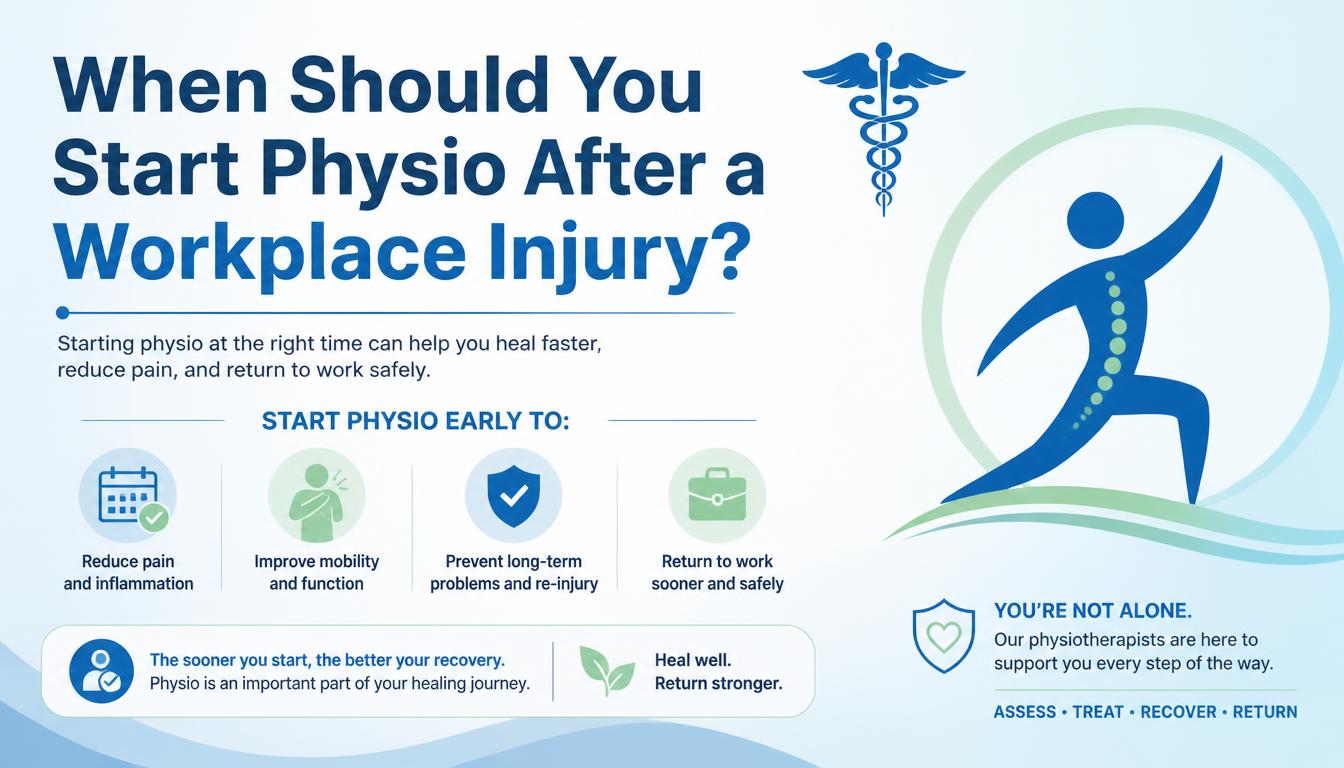















































































































































































































































































































































































































































































































































































































































































































































































































































































































































































































































































































































































































































































































































































































































































































































































































































































When Should You Start Physio After a Workplace Injury?


A workplace injury can leave you wondering what to do next. Should you rest for a few days? See a doctor? Wait for your WorkSafeBC claim to be approved? Or start physiotherapy right away?
For many workplace injuries, starting physiotherapy early can be an important part of recovery. In some circumstances, workers may even be able to access an initial physiotherapy assessment before their WorkSafeBC claim has been accepted.
If you have been injured at work in Langley, understanding when to seek physiotherapy can help you make informed decisions about your recovery and return to work.
This guide explains when physiotherapy may be appropriate, what to expect from a WorkSafeBC physiotherapy appointment, and how physiotherapy can support a safe and sustainable return to work.
Important: Every workplace injury is different. If you have severe symptoms, a suspected fracture, significant head or neck injury, chest pain, difficulty breathing, or another emergency, seek appropriate medical attention immediately.
Why Is Early Physiotherapy Important After a Workplace Injury?
After an injury, it can be tempting to completely rest until the pain disappears. While a short period of relative rest may sometimes be appropriate, prolonged inactivity isn’t necessarily the best approach for many musculoskeletal injuries.
Physiotherapy focuses on more than simply reducing pain. A physiotherapist can assess your movement, strength, mobility, functional abilities, and how the injury is affecting your ability to perform everyday or job-related activities.
WorkSafeBC emphasizes recovery and safe return to work, including helping workers understand what they can do during recovery rather than focusing exclusively on what they cannot do.
For example, a worker recovering under a WorkSafeBC claim with a back strain may need to gradually restore lifting capacity. Someone with a shoulder injury may need to rebuild range of motion and strength before returning to repetitive overhead work. A worker with a knee injury may require progressive exercises before safely returning to prolonged standing, climbing, or physical labour — which is where working with a physio in Langley experienced in WorkSafeBC claims makes a real difference in getting back to work safely. Our WorkSafeBC physio program in Langley is built around exactly this kind of gradual, job-specific recovery.
Early assessment can help establish a starting point and provide a structured plan for progressing toward those activities.
So, When Should You Start Physiotherapy?
For many work-related sprains and strains, the answer is: as soon as reasonably possible after the injury has been assessed and physiotherapy is appropriate.
You don’t necessarily have to wait until your symptoms become severe.
WorkSafeBC’s Early Access to Physiotherapy Program can provide eligible workers with quick access to an EAPP physiotherapist, potentially as early as the day of injury. The program is designed for certain recent sprain and strain injuries and operates alongside an employer’s established return-to-work program.
Even outside that particular program, WorkSafeBC’s health-care guidance allows contracted physiotherapists to perform an initial assessment for workers with accepted or pending claims. WorkSafeBC states that an initial assessment can be performed within 60 days of the injury for an accepted or pending claim; treatment beyond the assessment requires the claim to have been accepted.
This means you shouldn’t assume that you have to sit at home waiting for every part of the claim process to be completed before seeking an assessment.
What Should You Do Immediately After a Workplace Injury?
Before worrying about physiotherapy appointments, there are several important steps to take.
1. Tell your employer about the injury
Let your employer or supervisor know about the injury as soon as it is safe to do so.
This is particularly important if you need medical attention or your injury affects your ability to perform your normal duties.
WorkSafeBC recommends that injured workers notify their employer as soon as possible and report the injury to WorkSafeBC promptly.
2. Seek appropriate medical attention
Not every workplace injury is suitable for physiotherapy alone.
Depending on what happened and the symptoms you are experiencing, you may need assessment by a physician, nurse practitioner, emergency department, or another appropriate health-care professional.
When receiving medical care, tell the provider that the injury happened at work.
3. Report your workplace injury
WorkSafeBC recommends reporting a work-related injury as soon as possible. Workers can report certain injuries online, while some situations are better handled by phone.
Providing accurate information about when and how the injury happened can help WorkSafeBC assess your claim.
4. Ask about physiotherapy
If physiotherapy is appropriate for your injury, ask your health-care provider or WorkSafeBC about your options.
You can also contact a physiotherapy clinic that provides WorkSafeBC services and explain that your injury is work-related.
WorkSafeBC advises workers who need physiotherapy to use a contracted provider in their region when possible.
Do You Have to Wait for Your WorkSafeBC Claim to Be Accepted?
This is one of the most common questions injured workers have.
The short answer is not necessarily.
According to WorkSafeBC, workers can receive an initial physiotherapy assessment through a contracted provider even before their claim is accepted. If treatment is received before the claim is accepted, payment arrangements can depend on the circumstances.
WorkSafeBC also explains that contracted physiotherapists can perform an initial assessment for workers with accepted or pending claims.
However, the rules around ongoing treatment and payment are important.
For example, WorkSafeBC states that treatment beyond the initial assessment should only proceed once the claim has been accepted. If you choose a non-contracted provider, you may need to pay directly and seek reimbursement, with reimbursement subject to established rates.
Because claim circumstances vary, it is sensible to confirm coverage and provider requirements rather than assuming all appointments will automatically be covered.
What Happens During Your First WorkSafeBC Physiotherapy Appointment?
Your first physiotherapy appointment generally begins with an assessment rather than immediately jumping into an intensive exercise program.
Your physiotherapist may ask questions such as:
-
How did the workplace injury happen?
-
When did it occur?
-
Where do you feel pain or other symptoms?
-
What activities make your symptoms worse?
-
What activities can you currently perform?
-
What are your normal job duties?
-
Have you missed work?
-
Are you currently working modified duties?
-
What movements or tasks are difficult?
-
What are your recovery and work goals?
Your physiotherapist may also assess areas such as movement, strength, flexibility, balance, coordination, and functional abilities.
For a worker whose job involves lifting, for example, the assessment may consider how the injury affects lifting, carrying, bending, pushing, or pulling.
For someone who works at a desk, the assessment may focus more on posture, movement, tolerance for sitting, and upper-body or neck function.
The goal isn’t simply to determine whether something hurts. It’s to understand how the injury affects your ability to function and work.
WorkSafeBC’s physiotherapy reporting requirements include information about a worker’s functional abilities, treatment plan, and return-to-work considerations.
Does Physiotherapy Mean You Need to Stop Working?
Not necessarily.
In fact, WorkSafeBC emphasizes that returning to work when it is safe and appropriate can be beneficial for many injured workers.
Returning to work doesn’t always mean immediately going back to your normal job duties.
Instead, your recovery may involve modified or suitable work.
For example, a construction worker with a back injury might temporarily avoid heavy lifting while continuing with lighter duties.
A warehouse employee with a shoulder injury might reduce repetitive overhead tasks.
An office worker with a neck or upper-back injury might temporarily modify workstation setup, task duration, or work breaks.
The specific plan depends on the worker, injury, job demands, and recovery progress.
WorkSafeBC recommends collaboration between the worker and employer to identify safe and suitable work during recovery.
Your physiotherapist can provide information about your current functional abilities and help you understand what activities may be appropriate as you recover.
Why “Rest Until It Stops Hurting” Isn’t Always the Best Strategy
Pain naturally makes people cautious.
After a workplace injury, you may feel that avoiding movement completely is the safest option. In some cases, temporary protection of an injured area is appropriate. But for many musculoskeletal conditions, gradually restoring movement and function is an important part of rehabilitation.
WorkSafeBC encourages health-care providers to educate workers about the difference between hurt and harm and to encourage appropriate activity during recovery.
A physiotherapist can help determine which movements are appropriate now and which should be introduced gradually.
The goal is not to push through severe pain.
Instead, rehabilitation should be appropriately progressed according to your condition, functional abilities, and recovery goals.
What Types of Workplace Injuries Can Physiotherapy Help With?
Physiotherapy is commonly used as part of rehabilitation for many musculoskeletal workplace injuries.
These may include:
-
Back strains and other lower-back injuries
-
Neck injuries
-
Shoulder strains and injuries
-
Knee injuries
-
Ankle and foot injuries
-
Wrist and hand injuries
-
Elbow injuries
-
Muscle strains
-
Joint sprains
-
Repetitive or overuse injuries
-
Mobility and strength limitations following certain injuries
The appropriate treatment depends on the specific diagnosis and circumstances.
A physiotherapy assessment can help determine whether physiotherapy is appropriate and what type of rehabilitation may be useful.
How Long Should You Wait If Your Pain Seems Mild?
Mild symptoms can sometimes be misleading.
A worker might experience manageable discomfort immediately after an incident but develop increased stiffness, weakness, or difficulty performing job duties over the following days.
That’s one reason it’s important not to ignore a workplace injury simply because the initial pain isn’t severe.
If the injury occurred at work, document what happened, notify the appropriate people, and seek professional guidance when needed.
Early assessment can also provide a baseline against which your recovery can be monitored.
That doesn’t mean every minor ache requires extensive treatment. It means that the decision about whether you need physiotherapy should be based on your injury and functional needs rather than simply waiting for symptoms to become severe.
How Physiotherapy Supports a Return-to-Work Plan
A successful rehabilitation plan should consider more than your symptoms.
It should consider the demands of your actual job.
WorkSafeBC’s guidance for health-care providers highlights the importance of assessing functional abilities and supporting recovery-at-work planning.
Your physiotherapist may help identify:
-
Which movements you can perform safely
-
How much weight you can currently handle
-
Whether repetitive tasks are tolerated
-
How long you can stand, walk, sit, or work
-
Which activities should temporarily be modified
-
What physical abilities need to improve before full duties
-
How rehabilitation can progress toward your normal job requirements
In some circumstances, WorkSafeBC may involve rehabilitation services that include job-site visits, return-to-work planning, monitoring, or job-demand analysis.
This approach can make rehabilitation more practical because the goal isn’t simply to feel better in the clinic. The goal is to help you safely regain the abilities you need for everyday life and work.
What If You Are Already Back at Work but Still Have Pain?
You don’t necessarily need to be completely off work to benefit from physiotherapy.
Many injured workers continue working with temporary modifications while they recover.
If you are able to perform some duties but struggle with particular tasks, physiotherapy may help identify ways to gradually improve your capacity.
WorkSafeBC notes that returning to work as soon as it is safe can support physical and mental health, maintain workplace connections, and reduce the risk of long-term disability.
The important distinction is between safe activity and activity that aggravates or delays recovery.
If your current duties are causing your symptoms to worsen or preventing progress, communicate this with your employer and health-care providers so your recovery plan can be reviewed.
What If Your Injury Is Getting Worse?
Don’t simply push through worsening symptoms.
If your pain, weakness, swelling, numbness, mobility problems, or other symptoms are increasing, contact an appropriate health-care professional for reassessment.
Some symptoms may require medical investigation rather than routine physiotherapy.
If you experience an emergency or potentially serious symptoms, seek urgent medical care.
Your physiotherapist can also help determine whether your rehabilitation program needs to be modified or whether further medical assessment is appropriate.
How Does WorkSafeBC Monitor Physiotherapy Progress?
Physiotherapy for a workplace injury isn’t intended to continue indefinitely without evaluating progress.
WorkSafeBC has specific reporting processes for physiotherapists. Its current physiotherapy treatment report is used to provide updated information about a worker’s progress, functional abilities, and next steps in care, including requests for continued treatment or discharge reporting.
This reinforces an important principle: rehabilitation should have meaningful goals and should evolve as your condition changes.
Your treatment plan may initially focus on pain control and mobility and later progress toward strengthening, endurance, functional activities, and work-specific demands.
Choosing a WorkSafeBC Physiotherapy Clinic in Langley
If you’re looking for physiotherapy after a workplace injury in Langley, consider asking the clinic:
-
Do you provide physiotherapy for WorkSafeBC claims?
-
Are your physiotherapists contracted with WorkSafeBC?
-
Can you assess workers with accepted or pending claims?
-
What information should I bring to my first appointment?
-
How do you communicate functional abilities and work restrictions?
-
Can you help with a gradual return-to-work plan?
-
Do you have experience treating injuries similar to mine?
Choosing a provider familiar with workplace rehabilitation can make it easier to coordinate your clinical recovery with your work requirements.
Don’t Wait for a Workplace Injury to Become a Bigger Problem
So, when should you start physiotherapy after a workplace injury?
For many musculoskeletal workplace injuries, earlier assessment is preferable to unnecessarily delaying care. WorkSafeBC has programs and processes designed to provide timely access to physiotherapy in appropriate circumstances, including early access for certain eligible sprain and strain injuries.
The right timing, however, depends on the injury.
The first priorities are to make sure you receive appropriate medical attention, report the workplace injury, communicate with your employer, and determine whether physiotherapy is suitable.
If physiotherapy is recommended, an early assessment can help establish your current abilities, identify limitations, develop an individualized rehabilitation plan, and support a safe progression back toward your regular activities.
For workers in Langley, the objective isn’t simply to get rid of pain as quickly as possible. The bigger goal is to restore movement, strength, confidence, and functional capacity so you can return to work safely and sustainably.
If you’ve recently experienced a workplace injury, don’t feel that you have to figure out the rehabilitation process alone. Speak with an appropriate health-care professional and your employer, and make sure you understand your WorkSafeBC claim and treatment options.