

 English



























































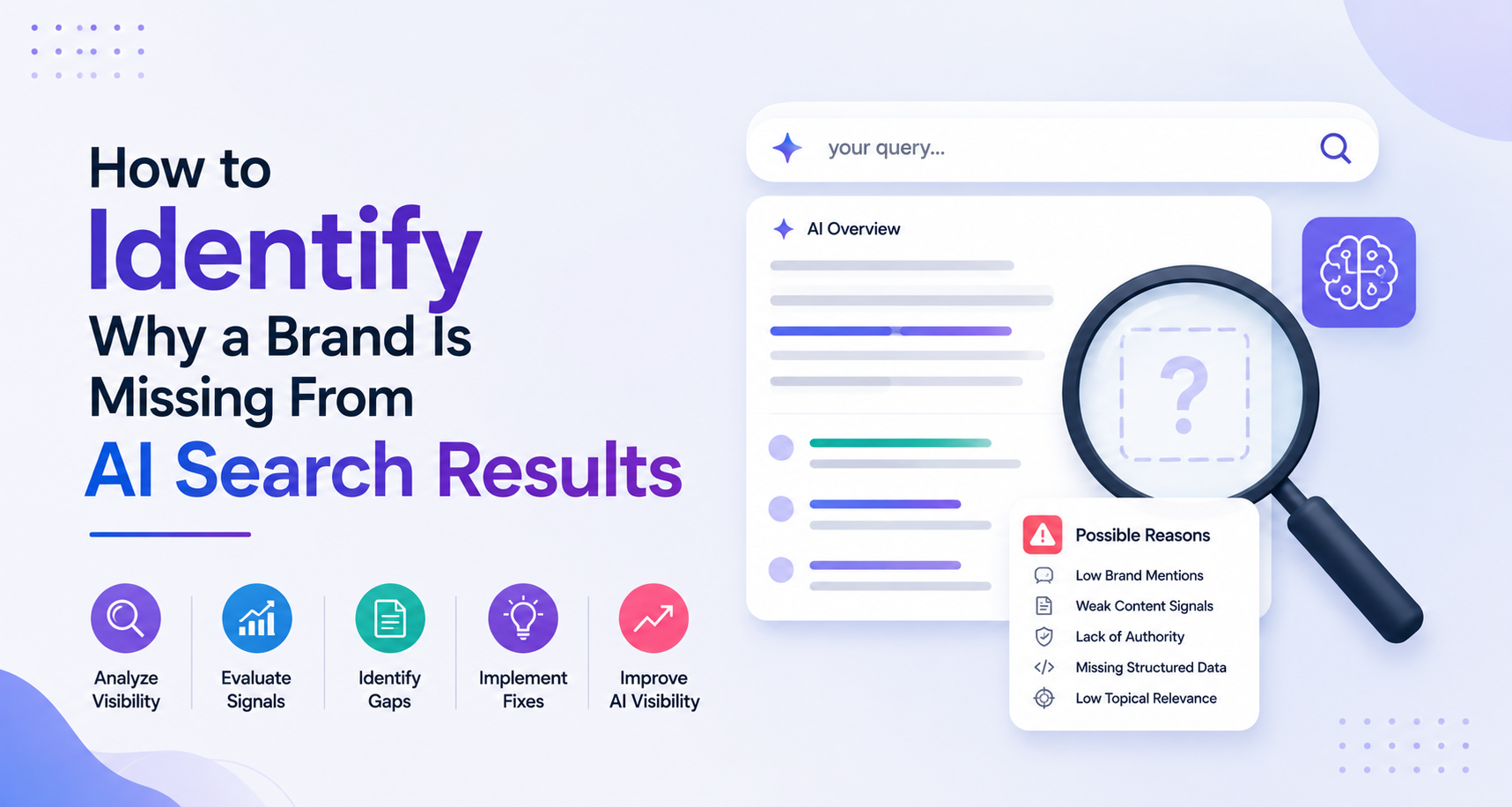

















































































































































































































































































































































































































































































































































































































































































































































































































































































































































































































































































































































































































































































































































































































































































































Why Your Brand Is Missing From AI Search Results

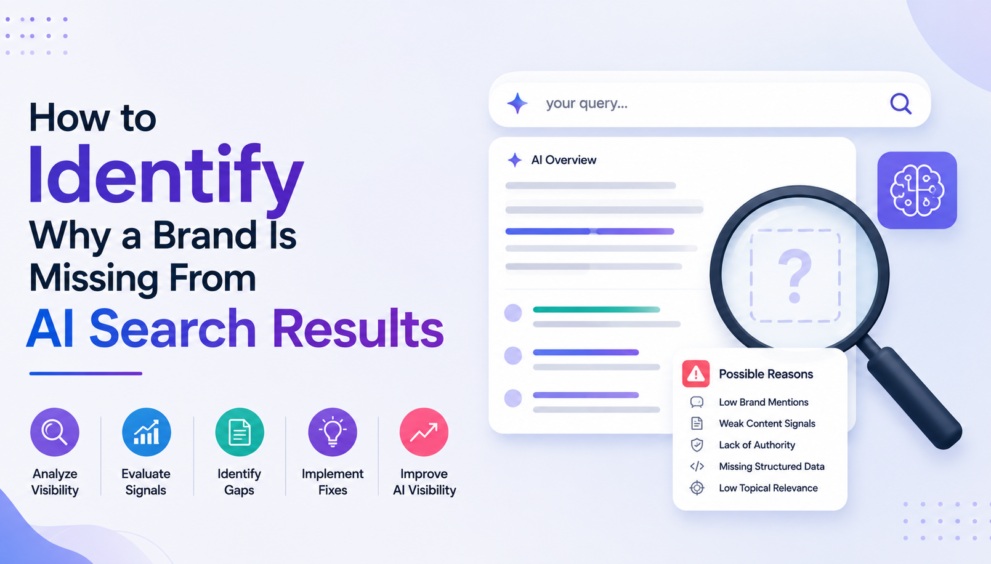
A brand can have strong organic rankings and still be missing when customers ask ChatGPT, Gemini, Claude, or Perplexity for recommendations. This can be confusing because traditional SEO performance does not always translate directly into visibility across AI-generated answers.
The first step is to stop treating AI visibility as a simple ranking problem. AI systems look at information from different sources, compare entities, interpret context, and decide which brands are relevant to a specific question. A brand may therefore be well established in Google search but still have limited presence in AI answers.
This is where AI SEO Services become relevant, particularly for businesses trying to understand why competitors are being mentioned more often and what signals may be missing from their online presence.
Start With the Questions Customers Actually Ask
Before trying to fix AI visibility, identify the prompts that matter to the business.
Searching for the brand name alone is not enough. A customer may never ask an AI platform:
“Tell me about [Brand].”
They may instead ask:
“What are the best accounting platforms for small businesses?”
“Which CRM is best for a growing technology company?”
“What are reliable payroll providers in the US?”
These broader questions are often more useful for measuring whether a brand is being considered during the discovery and comparison stage.
Create a list of prompts based on:
- Core products or services
- Main customer problems
- Industry-specific needs
- Product comparisons
- “Best” and “top” searches
- Location-based searches
- Alternative and competitor searches
- Buying questions
- Questions frequently asked by sales teams
Run these prompts consistently across the AI platforms that matter to the business.
Is the Brand Missing Completely or Just Being Outranked by Competitors?
There is an important difference between these two situations.
If an AI platform repeatedly mentions competitors but never mentions the brand, there may be a brand recognition or information gap.
If the brand appears occasionally but competitors are mentioned more often, the problem may be related to relevance, authority, or how clearly the brand is associated with the category.
Track what happens across a set of relevant prompts.
For example:
Prompt: “What are the best enterprise payroll platforms?”
Result: Competitor A, Competitor B, Competitor C
Your brand: Not mentioned
Then change the prompt:
Prompt: “What are some alternatives to Competitor A for enterprise payroll?”
If the brand still does not appear, that gives you a stronger signal that the problem goes beyond one particular prompt.
What Information Does AI Have About the Brand?
AI systems need enough reliable information to understand what a company does and where it fits within a market.
Review the information available across the brand’s website and other trusted sources.
Can someone clearly understand:
- What the company sells?
- Who its products or services are for?
- Which industries it serves?
- Where it operates?
- What problems it solves?
- What makes its offering different?
- Which products are its core offerings?
A vague company description can make this harder.
For example, saying that a company is an “innovative technology leader” provides little useful information.
A clearer description explains what the company actually provides, who uses it, and what problem it solves.
The goal is not to write content specifically for an AI system. The goal is to make the brand’s identity and relevance easier to understand everywhere it is discussed.
Are Other Websites Talking About the Brand?
This is one of the most important areas to investigate.
A brand’s own website controls only one part of its online presence. AI systems can encounter information through publishers, industry websites, review platforms, directories, forums, comparison sites, and other sources.
Search for the brand outside its own website.
Look for:
- Industry publications
- Independent reviews
- Business directories
- Product comparison websites
- Customer discussions
- Expert articles
- Partner websites
- News coverage
- Industry reports
Then compare the brand’s presence with the competitors that frequently appear in AI answers.
If competitors are consistently mentioned across trusted third-party sources while the brand has very little independent coverage, that difference can help explain the visibility gap.
Are the Brand’s Products and Services Clearly Defined?
AI search often involves category-level questions.
For a brand to become a relevant recommendation, its products need to be clearly associated with the categories and use cases customers search for.
Suppose a company sells software for healthcare organizations.
Its website should make the connection between the company, its software, and the healthcare use cases easy to understand.
That connection should not exist only on one product page. It can also appear naturally through:
- Product descriptions
- Industry pages
- Customer stories
- Expert articles
- Comparison content
- Partner references
- Independent reviews
The stronger the consistent association, the easier it becomes to understand where the brand fits.
Could Conflicting Information Be Hurting Brand Recognition?
Inconsistent information can create unnecessary confusion.
Check whether the company’s:
- Business description
- Product names
- Service categories
- Locations
- Company information
- Leadership details
- Industry focus
- Product features
are consistent across important online sources.
For example, if one website describes a company as an enterprise cybersecurity provider while another presents it primarily as a consumer security brand, the difference may affect how clearly the business is understood.
This does not mean every description needs to use exactly the same wording. The underlying facts should simply remain accurate and consistent.
Does the Website Answer the Questions Behind the Prompt?
An AI answer often needs context before recommending a company.
A product page may explain what a product does, but it may not answer the questions a potential buyer has before choosing it.
Look at the topics surrounding your main products and services.
For example, a buyer might want to know:
- Who is this product suitable for?
- What business problem does it solve?
- How does it compare with alternatives?
- What industries use it?
- What features matter most?
- What should buyers consider before choosing a solution?
If the website provides clear answers to these questions, it gives search engines and AI systems more useful context about the brand.
Are Competitors Building Stronger Topic Associations?
Sometimes the problem is not that a brand lacks content. It is that competitors have built stronger associations around the topics that matter.
Imagine three companies competing in the same software category.
One competitor is repeatedly mentioned in content about:
- Enterprise use cases
- Security
- Integrations
- Scalability
- Industry-specific solutions
Another competitor is strongly associated with small businesses and ease of use.
If your brand publishes general content across many unrelated subjects, its position in the category may be less clear.
This is why topical relevance matters more than simply producing a large amount of content.
The objective is to build a clear relationship between the brand, its expertise, its products, and the problems it solves.
Could Weak Traditional SEO Be Part of the Problem?
AI search has changed the way people discover information, but traditional SEO still provides an important foundation.
Check the basics:
- Important pages are indexed
- Internal links connect related content
- Product and service information is crawlable
- Page content matches search intent
- Structured data is implemented where appropriate
- Important pages are not blocked
- Content is clear and up to date
A technical issue will not necessarily explain every AI visibility problem, but it should not be ignored.
AI visibility should be treated as an extension of a strong digital presence rather than a completely separate marketing activity.
How Do You Know What Needs to Be Fixed?
Once the research is complete, group the findings instead of treating every missing mention as the same problem.
If the brand is rarely mentioned anywhere
Focus on building broader brand recognition and credible third-party references.
If the brand is known but rarely associated with its category
Strengthen the connection between the brand, its products, services, use cases, and target audience.
If competitors dominate comparison prompts
Review competitor positioning, comparison content, reviews, and third-party coverage to understand why they are being selected more frequently.
If the brand appears for some prompts but not others
Compare the intent of those prompts. The difference may reveal where the brand has stronger relevance and where additional authority or topical coverage is needed.
If the brand has strong visibility but incorrect information appears
Prioritize factual accuracy and consistency across important sources.
This approach is more useful than trying to make a brand appear in every AI answer.
Measure Progress With a Consistent Prompt Set
AI results can change depending on the wording of a question, so one-off testing can be misleading.
Build a repeatable set of important prompts and record:
- Whether the brand is mentioned
- Which competitors are mentioned
- How the brand is described
- What sources appear to influence the answer
- Whether the information is accurate
- Whether the brand appears for commercial, informational, and comparison prompts
Run the same set periodically.
This creates a clearer picture of whether visibility is improving rather than relying on individual AI responses.
The Real Goal Is Better Brand Relevance
There is no reliable shortcut that guarantees an AI platform will mention a particular company.
The stronger approach is to build a digital presence that makes the brand easy to understand, relevant to its category, and supported by credible information across the web.
That means looking beyond the brand’s own website.
If customers, publishers, industry sources, partners, and review platforms consistently connect the company with its products and areas of expertise, the brand has a stronger foundation for appearing in AI-generated recommendations.
Final Thoughts
When a brand is missing from AI search results, the answer is rarely as simple as adding a few keywords to a webpage.
The better starting point is diagnosis.
Find the prompts where competitors appear. Check how the brand is described. Review the information available across third-party sources. Look for gaps in product and category associations. Compare the brand’s topical coverage and authority with competitors. Then determine whether the problem is visibility, relevance, recognition, accuracy, or a combination of these factors.
For businesses investing in AI SEO Services, this type of analysis can provide a clearer way to understand and improve AI search visibility. The focus should not be on trying to force a brand into AI-generated answers. Instead, businesses should build strong, consistent signals across their website and the wider web so AI systems can clearly understand what the brand does, who it serves, and where it fits within its category.
As a performance-driven SEO agency, ResultFirst takes a data-led approach to AI search visibility, looking at brand mentions, competitor presence, content gaps, and third-party signals to identify where a brand may be losing visibility. The goal is to understand the reason behind the gap first, then build a strategy around the areas that can genuinely improve brand recognition in AI-powered search.