

 English

























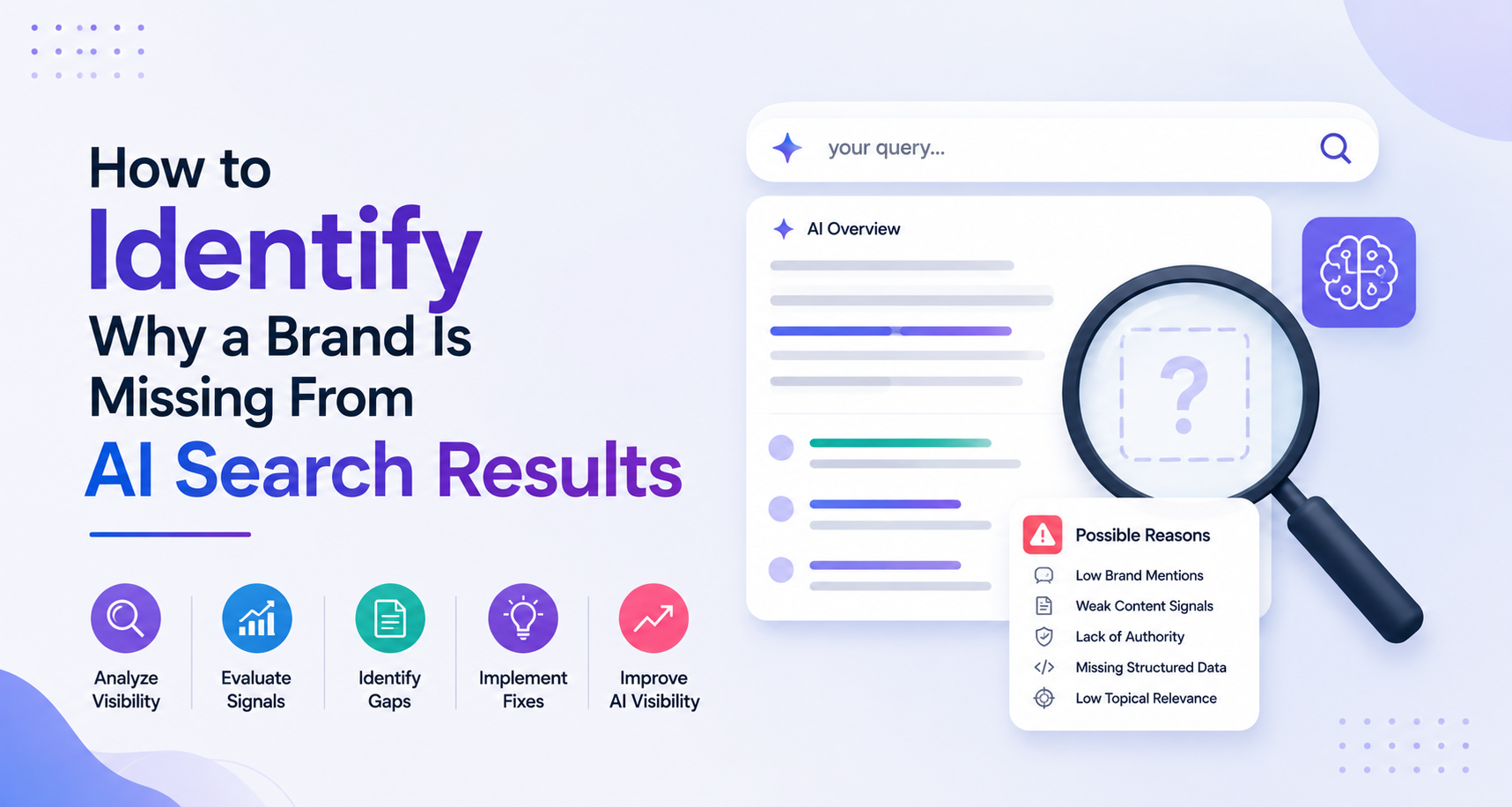






































































































































































































































































































































































































































































































































































































































































































































































































































































































































































































































































































































































































































































































































































































































































































































Why AI Search Recommends Competitors Instead of Your Brand


When a customer asks ChatGPT, Gemini, Perplexity, or another AI search platform to recommend the best company, product, or service in your category, you may expect your brand to appear. But sometimes the answer keeps mentioning competitors, even when your website ranks well in traditional search.
That does not necessarily mean your competitors have better products or services. AI search evaluates information differently. It looks for clear, relevant, accessible, and corroborated information that helps it build an answer. Your brand may have strong website content but still lack the signals that make it easy for AI systems to understand, verify, and confidently mention.
This is where AI search optimization services can become useful. The goal is not simply to add more keywords or create more content. It is to identify why your brand is being overlooked and strengthen the information and authority signals that influence AI-driven discovery.
Why Does AI Search Recommend Competitors Instead of Your Brand?
AI platforms do not simply select the websites that rank highest in Google and turn them into recommendations.
When someone asks:
“What are the best companies for [service]?”
the system may consider several sources before generating its answer. It can look at information about the companies, their products or services, customer experiences, industry reputation, comparisons, and other relevant sources available to it.
This creates a situation where a competitor can be recommended even if your website performs well in traditional organic search.
For example, your brand might rank highly for enterprise accounting software, while a competitor receives more AI recommendations for:
“Which accounting software is best for large businesses with multiple entities?”
The second query has a different intent. It requires the AI system to understand not only the category but also the specific use case.
If your competitor has more evidence connecting its brand with that use case, it may be considered a better answer.
What Signals Influence Brand Recommendations in AI Search?
AI search visibility is influenced by multiple signals rather than one ranking factor.
Some of the most important areas to examine include:
- Brand and entity clarity
- Relevant website content
- Topical depth
- Customer and industry use cases
- Third-party mentions
- Reviews and discussions
- Industry publications
- Brand consistency across the web
- Technical accessibility of important content
- Relationships between your products, services, topics, and audience
These signals help AI systems build a clearer understanding of a company.
Think of it as a knowledge network:
Brand → Category → Product/Service → Use Case → Audience → Expertise → Supporting Sources
The stronger and more consistent these relationships are, the easier it is for an AI system to determine where your brand fits into a particular answer.
Traditional SEO Rankings Do Not Guarantee AI Search Visibility
One of the biggest misconceptions about AI search is that a top Google ranking automatically means your brand will be recommended by AI.
It does not.
Traditional search often focuses heavily on matching a page to a query and determining which results are most useful for that search.
AI search can take a more conversational approach. A user might ask a detailed question containing several requirements, and the system needs to identify which brands best match those requirements.
For example:
Traditional search query:
“best CRM software”
AI search query:
“I run a 200-person B2B sales team. Which CRM platforms have strong automation, reporting, and integration capabilities?”
The second question contains much more context.
A brand that has clearly documented its enterprise capabilities, integrations, customer use cases, limitations, and industry applications may have a stronger chance of being considered.
This is why improving AI visibility should complement, rather than replace, traditional SEO.
How Third-Party Mentions Can Strengthen AI Brand Visibility
Your own website can explain what your company does, but independent sources provide another layer of evidence.
Consider two competing brands.
Brand A has strong first-party content
Its website includes:
- Detailed service pages
- Product documentation
- Blog content
- Case studies
- FAQs
But very few independent websites discuss the company.
Brand B has a broader online footprint
In addition to its website, Brand B appears in:
- Industry publications
- Expert articles
- Product comparisons
- Review platforms
- Partner websites
- Customer discussions
- Industry directories
AI systems can use information from multiple sources when forming an answer. A strong third-party footprint can therefore help reinforce the connection between a brand and the category or use cases it serves.
This does not mean businesses should pursue random brand mentions simply to increase volume. Relevant and credible sources are far more useful than large numbers of unrelated mentions.
Content Gaps Can Make Competitors Easier for AI to Recommend
Many brands create content around the keywords they want to rank for but overlook the questions customers ask before choosing a provider.
Suppose you sell cybersecurity software.
Your website may have pages targeting:
- Cybersecurity software
- Network security
- Endpoint protection
- Threat detection
But customers may actually ask:
- Which cybersecurity solution is best for a mid-sized healthcare company?
- What should I look for when replacing endpoint security software?
- How much does enterprise cybersecurity software cost?
- What are the most important cybersecurity capabilities for remote teams?
- What are the differences between managed and in-house security?
If competing brands consistently answer these questions, AI systems have more context connecting those brands with specific buying situations.
Build Content Around Decisions, Not Just Keywords
A stronger AI search content strategy considers the entire decision process.
That means creating resources around:
Problems → Questions → Options → Comparisons → Use Cases → Evaluation → Decision
For example, instead of publishing another generic article called:
“Benefits of CRM Software”
you could create:
“How to Choose a CRM for a Growing B2B Sales Team”
The second topic gives you opportunities to explain selection criteria, integrations, reporting, automation, scalability, implementation challenges, and other details that customers actually care about.
Brand Positioning Needs to Be Consistent Across the Web
AI systems need to connect different pieces of information about the same entity.
If your website describes your company as an enterprise software provider, while major third-party sources describe it primarily as a consulting firm, the overall picture may become less clear.
Check whether important sources consistently communicate:
- What your company does
- Which category it belongs to
- Who it serves
- What products or services it provides
- Which industries it specializes in
- What problems it solves
- Where it operates
- What differentiates its offering
This is particularly important for companies that have changed their positioning, expanded into new markets, launched new products, or operate several brands.
AI Search Needs Clear Answers to Specific Customer Questions
AI-generated answers are built to satisfy questions, not simply display a list of pages.
That makes clarity especially important.
A strong page should make important information easy to identify rather than forcing users or search systems to interpret vague marketing language.
For example:
Weak:
“We deliver innovative solutions designed to transform your business.”
Stronger:
“Our platform helps multi-location retailers manage inventory, purchasing, and fulfillment from one system.”
The second statement gives much more context.
It identifies:
- The product
- The audience
- The use case
- The business problem
That kind of specificity can make content more useful for both people and search systems.
What Should You Audit When Competitors Dominate AI Answers?
Before creating hundreds of new pages, find out why competitors are appearing.
Start by testing realistic customer questions across the AI platforms your audience uses.
Look beyond generic queries and include:
Category queries
- What are the best [product/service] providers?
- Who are the leading companies in [category]?
- What companies specialize in [specific service]?
Problem-based queries
- How can a business solve [specific problem]?
- What is the best solution for [specific situation]?
- What should companies consider when dealing with [problem]?
Comparison queries
- What are the best alternatives to [competitor]?
- Which companies compete with [competitor]?
- How does [brand] compare with other providers?
High-intent queries
- Which provider is best for [specific audience]?
- How much does [service/product] cost?
- What should I look for when choosing a [provider/product]?
Then record:
- Which brands are recommended
- Which brands are cited
- Which sources are referenced
- Which customer attributes influence the recommendation
- What competitors are associated with that use case
- Whether your brand is mentioned but not recommended
This can reveal whether the problem is primarily content, brand context, third-party authority, technical accessibility, or a combination of these factors.
When Does AI Search Optimization Become Necessary?
AI search optimization becomes particularly valuable when your customers increasingly use conversational platforms to research products, services, or providers.
The objective is not to manipulate AI responses or guarantee that your brand will appear for every prompt. No legitimate optimization strategy can promise that.
Instead, the work focuses on making your brand easier to understand and support with credible information.
A practical AI search optimization process can include:
AI visibility research:
Identify the questions customers are asking and determine where your brand currently appears.
Competitor analysis:
Study why competing brands are being mentioned, cited, or recommended.
Entity optimization:
Strengthen the relationships between your brand, category, products, services, audience, and areas of expertise.
Content optimization:
Improve existing pages and create useful resources around customer questions and decision-making criteria.
Third-party visibility:
Identify relevant publications, industry resources, reviews, and other sources that can independently reinforce your expertise.
Technical SEO:
Make important information accessible, crawlable, indexable, and logically connected throughout the website.
The emphasis should remain on building a stronger information ecosystem around the brand rather than trying to optimize for one AI platform or one prompt.
How Do You Know If AI Search Visibility Is Improving?
AI visibility should not be judged only by whether your brand appears in one answer.
AI responses can change based on the question, context, platform, location, available sources, and other factors.
Instead, track broader patterns such as:
- Frequency of brand mentions
- Frequency of brand recommendations
- Citation frequency
- Sources being used to describe your company
- Competitors appearing alongside your brand
- Questions where your brand gains or loses visibility
- Accuracy of AI-generated descriptions of your company
- Referral traffic from AI platforms
- Leads or conversions influenced by AI-driven discovery
The most useful question is not simply:
“Did ChatGPT mention us?”
It is:
“Is our brand becoming consistently associated with the topics, products, services, and customer problems we want to be known for?”
That gives you a much stronger view of whether your AI search strategy is working.
The Goal Is to Become an Obvious Answer, Not Just Another Mention
When AI search repeatedly recommends your competitors, the answer is not necessarily to publish more blog posts or add more keywords.
The deeper issue may be that competitors have built a stronger and clearer information footprint.
AI systems need enough reliable context to understand:
Who you are → what you offer → who you serve → what problems you solve → why you are relevant.
If that information is fragmented, generic, or poorly supported by independent sources, another brand may appear to be the safer recommendation.
The opportunity is therefore bigger than ranking for a handful of AI-related queries. It is about building a brand presence that is clear, useful, consistent, and supported across the wider web.
As a performance-driven SEO agency, ResultFirst focuses on combining traditional search fundamentals with content, technical, and brand-level strategies that help businesses strengthen their visibility across evolving search experiences.